 Charles Schwab
 Fidelity
 Interactive Brokers
 E*TRADE
 Webull
 TradeStation
 tastytrade
 eToro
eToro Trading 212
 Interactive Investor
 IG
IG Interactive Brokers
 XTB
XTB Hargreaves Lansdown
 Saxo
Saxo Charles Stanley Direct
 CIBC Investor's Edge
 Interactive Brokers
 Moomoo
 Questrade
 Qtrade
 TD Direct Investing
 Wealthsimple
 Finviz
 Stock Rover
 Seeking Alpha
 StockHero
 TipRanks
 TrendSpider
 Trade Ideas
 TraderSync
 TradingView
 Tradervue
 TradeZella
Seeking Alpha Review

Written by David Rodeck
Contributing Writer

Fact-checked by Joey Shadeck
Research Analyst

Edited by Hannah Smith
Staff Editor
David RodeckContributing Writer
David Rodeck is a financial writer based in New York City. He specializes in making investing, trading, and retirement planning understandable.

Seeking Alpha is an investment research platform that blends market news, professional ratings, and a massive library of stock analysis from both experts and everyday investors. While basic investing sites can help you track prices and headlines, Seeking Alpha goes deeper by offering proprietary ratings, portfolio tools, and premium research built for investors who want more than surface-level data.
That said, getting full access isn’t cheap, and its premium plans can run into the hundreds (or even thousands) of dollars per year, depending on what tier you opt for. In this Seeking Alpha review, we’ll cover what you actually get at each subscription level, who the platform is best for, and whether the price matches the value.
-
Free version:
Yes -
Monthly Pricing:
N/A -
Annual Pricing:
$299.00/yr
| Ease of Use | |
| Features | |
| Cost |
Seeking Alpha pros and cons
PROS
- Massive database of research and articles.
- High-quality screener and portfolio analysis.
- Investment picks from top experts.
- Free plan with decent access.
CONS
- Expensive, especially for full access.
- No monthly subscriptions.
- Articles can range in quality.
- Research and articles are for experienced investors.
Overall summary
| Feature |
 Seeking Alpha Seeking Alpha
|
|---|---|
| Overall |
|
| Features |
|
| Ease of Use |
|
| Cost |
|
| Free version | Yes |
| Monthly Pricing | N/A |
| Annual Pricing | $299.00/yr |
Cost and plans
Seeking Alpha offers a free Basic subscription as well as two paid subscriptions, Premium and Pro. The paid plans let you sign up for a one-month trial at a reduced rate, before switching to an annual rate at the following costs:
Seeking Alpha plans compared
| Feature | Basic | Premium | Pro |
|---|---|---|---|
| Annual price | Free | $299 | $2,400 |
| Trial | N/A | 7-day free trial | $99 first month |
| Market news and public data | Yes | Yes | Yes |
| Stock and ETF screener | Basic filters | Quant and analyst ratings | Quant and analyst ratings |
| All articles | Limited | Yes | Yes |
| Earnings call transcripts | Limited | Unlimited | Unlimited |
| Quant Ratings and Factor Grades | No | Yes | Yes |
| Top analyst ideas | No | No | Top 50 analysts |
| Quant portfolio | No | No | Yes |
As you progress through the tiers, you gain access to more research and analyst investment recommendations. I found it a little annoying that they don’t have a month-by-month plan. A free trial of the paid plans would have been nice too, but you already get a solid test drive of all the capabilities with the free Basic plan.
Basic plan
You can access the Seeking Alpha screener, market news, and research by visiting its website. You don’t even have to create a free account. I loved how I could dive right in and start testing the stock screener for ideas for my Seeking Alpha review. That said, without an account, you’ll lose all your research and ideas as soon as you leave.
It only took 10 seconds to register for a free Basic plan by providing my email address and a password. Then I was able to save my portfolios to access market news and a wide range of publicly available financial information, such as dividend metrics and trading ranges.
While the Basic plan gave me some basic analysis, it was just enough to whet my appetite. For example, it told me my initial portfolio was in the top 10%, but hid the reasons why. I couldn’t screen based on expert analyst or quant ratings. I also couldn’t read most of the Seeking Alpha articles.
If you’re just looking for a simple place to track your holdings and collect market news, it’s fine, but nothing dramatically different from other free services like Yahoo Finance.
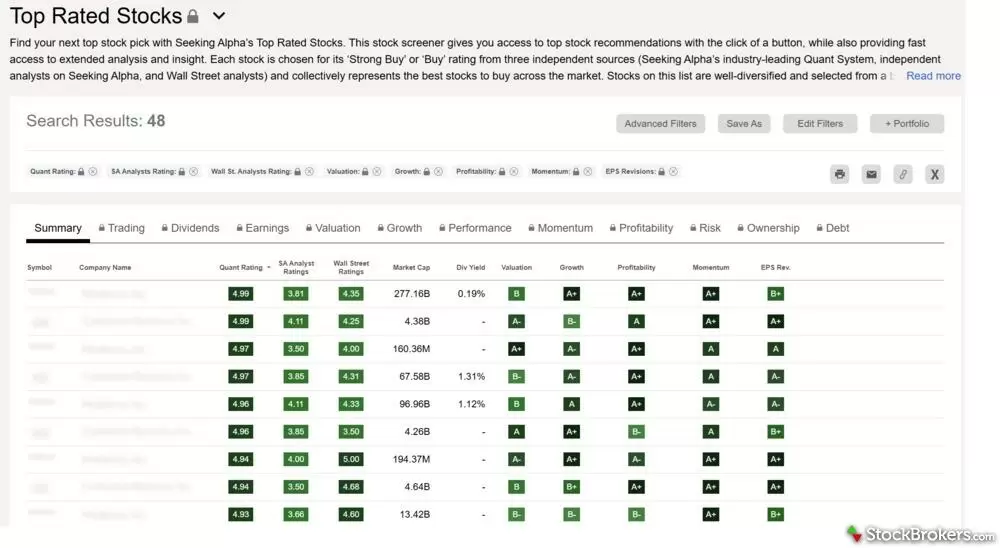
On the free version of Seeking Alpha, you can use the screener’s basic financial filters, but many premium metrics appear locked until you upgrade.
Premium plan
The Premium plan really opens up access to Seeking Alpha's capabilities and research. With this plan, you can sort stocks and ETFs on the screener using ratings from professional analysts and quants.
I’ve used many screeners before, but I was impressed by how quickly this one let me start with pre-built lists of target picks, then refine them using my own metrics. For example, I began with Seeking Alpha’s “Top Picks” based on analyst ratings, but then fine-tuned it to only medium-cap stocks with high dividends. Quickly enough, I had a targeted, specialized portfolio of companies I never would have found on my own.
As a Premium user, you can read all Seeking Alpha articles. Note that Alpha Picks is not part of Premium. It is a separate subscription, covered below.
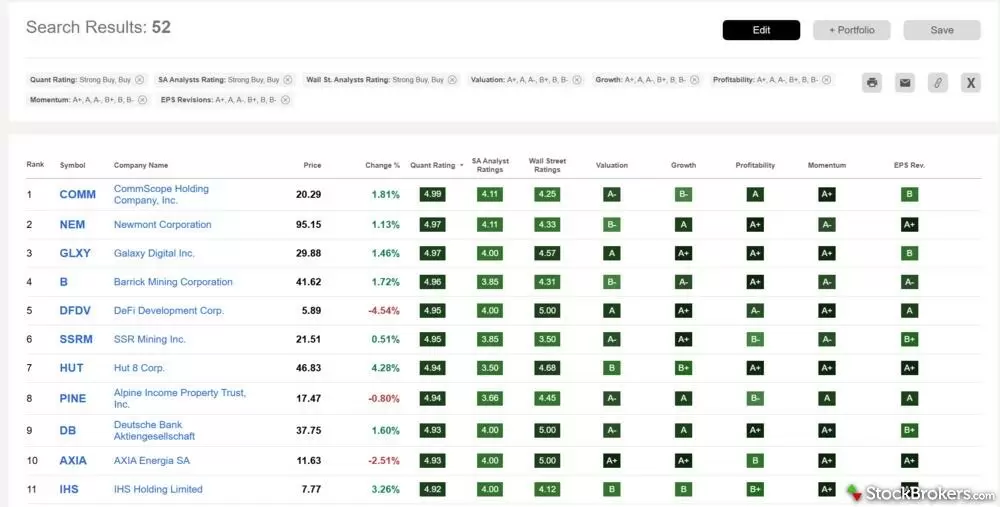
Upgrading to a paid subscription unlocks Seeking Alpha’s full screener, including advanced metrics and premium filters that aren’t available on the free plan.
Pro plan
At $2,400 a year, nearly 10 times the cost of Premium, the Seeking Alpha Pro plan is expensive to say the least. For all that money, you aren’t getting access to new tools or a fundamentally different experience. Instead, you’re shelling out for even rarer research, including ideas and picks from Seeking Alpha’s top 50 analysts that are only released to Pro users.
The biggest draw at the Pro tier is the Quant portfolio. It's a 30-stock portfolio built from Seeking Alpha's quant model and rebalanced weekly, and the platform sends the specific buy and sell trades you need to match it. You also get additional research on stocks in less-traded markets. Without extensive experience trading off Seeking Alpha's picks, it's hard for me to say if that steep price is worth it. Obviously, one great idea or two a year could certainly make up the fee and then some.
Features
Seeking Alpha operates as a crowdsourced platform to deliver market news, investment ideas, and portfolio analysis using its internal tools and research from its many users. Here are the top features you get with a Seeking Alpha subscription.
News, market data, and articles
Seeking Alpha provides an ocean of news, market data, trends, charts, and everything else that’s going on in the investment world. The public information is well organized and available to free users. Paid users also have other home page information based on Seeking Alpha data, such as the most compelling analyst ideas and top-rated picks of the day.
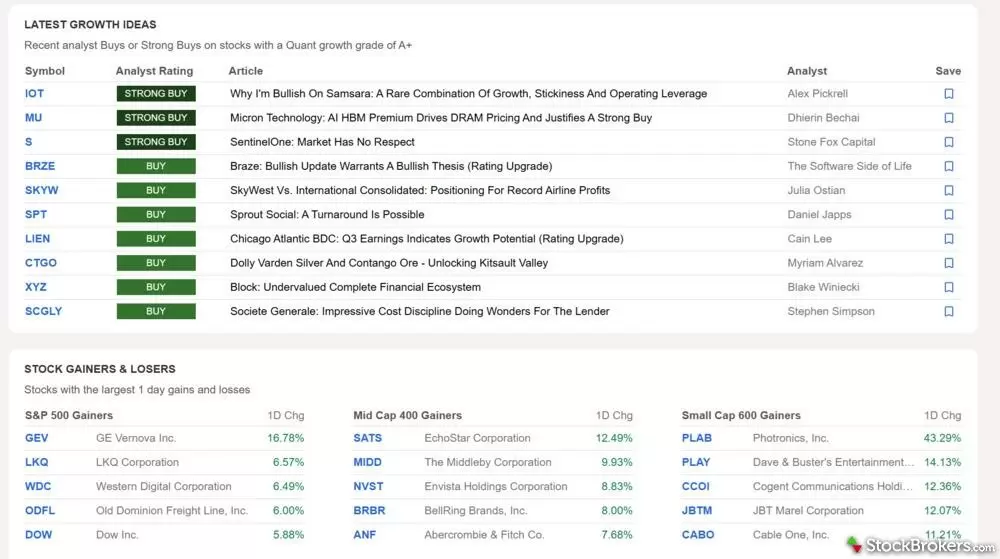
The Seeking Alpha homepage surfaces recent growth stock ideas alongside broader market news and analysis.
Paid users gain access to articles on a wide range of subjects, including AI tech, dividend strategies, forex, and undiscovered stocks. Just be warned that Seeking Alpha crowdsources the material, meaning anyone can submit. Articles must qualify through Seeking Alpha’s editorial process, but I imagine there’s a range in quality.
For example, even I, as a totally brand-new user, could submit articles for pay, about $151 each if approved. You’ll get lots of ideas and opinions, but some will be much more qualified than others.
Earnings call transcripts
Seeking Alpha publishes free earnings call transcripts, covering about 4,500 company calls each quarter. You can read them or listen to the audio, and many post within hours of the call ending. Free users can reach transcripts through stock symbol pages, but unlimited access, including keyword search across transcripts, is a Premium feature.
Stock and ETF screeners
Seeking Alpha offers an excellent range of screeners to help you identify your next investment opportunities. You can access it with a free account. As a free user, you can sort using the typical financial information found in most screeners, such as earnings, valuation, and risk metrics.
That said, the most valuable, proprietary information is hidden behind a lock icon, encouraging you to pay. However, you’ll get access to information like quant ratings showing whether professionals agree with a pick, or the dividend grades of stocks produced by Seeking Alpha.
As far as other features go, I liked many of the pre-built lists and screens Seeking Alpha had available, such as top stocks in different sectors (AI, consumer staples, financials, etc.), best dividend stocks, and most shorted stocks.
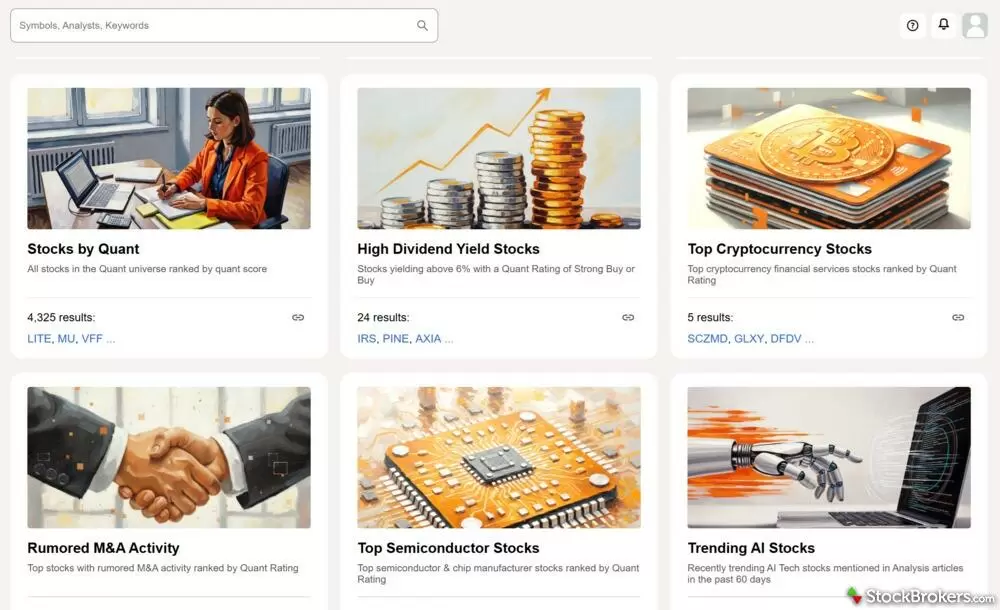
Instead of building screens from scratch, Seeking Alpha provides curated screener categories such as “Stocks by Quant” and “Trending AI Stocks.”
That gave me a head start on the research, and then from there I could refine even further using the screens. Once I found picks I liked from the screener, it was easy to move them to the Portfolio section.
Portfolio tracker, analysis, and alerts
The Seeking Alpha portfolio tracker is where you monitor your holdings. Free users can track prices and holdings, while broker linking for automatic daily updates is a paid feature. Once a portfolio is set up, each holding shows its Quant, SA Authors, and Wall Street ratings.
Seeking Alpha lets you set up portfolios for tracking and analysis. You can enter stock picks manually, grab them off the screener, upload a CSV file of investments, or sync your broker. I linked my Robinhood account, and it was a breeze.
From there, you’ll automatically get market news, data, and insights about your portfolio. You can also set up alerts by email or phone. But be warned, the alerts add up quickly if you request updates on news and articles. In less than 24 hours, my small test portfolio led to my inbox overflowing, so I had to turn that feature off.
I really appreciated the details and insights from the portfolio analysis. However, I was curious to see that I didn’t get perfect scores across the board. For instance, it only gave me a letter B grade for valuation, and when I dug deeper, I saw that one of my picks was considered grossly overvalued at its current market price, getting a D grade and dragging down my portfolio score. It was a mismatch with the high quality of the other 9. Cutting it from my portfolio improved my rating.
Initially, the platform said my sample portfolio was in the top 1% of all users on the platform (but before you congratulate me, remember that I pulled those picks directly from their best of list).
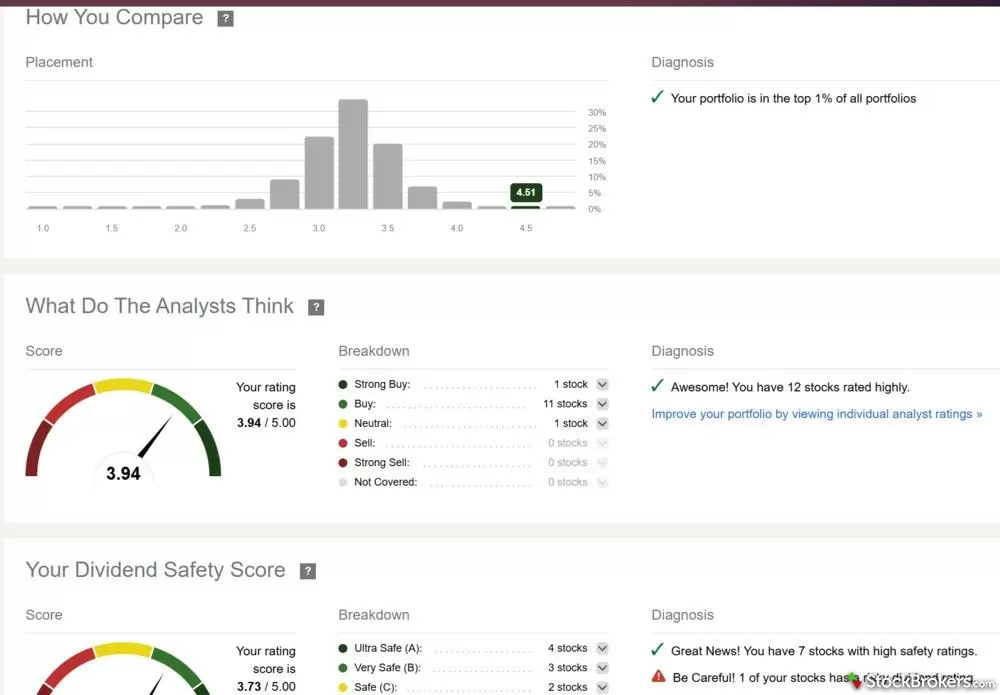
Seeking Alpha’s Portfolio Check makes it easy to review how analysts view your portfolio and identify potential safety concerns.
Combining the screener with portfolio analysis could help you find some hidden gems like this.
Portfolio recommendations
If you want more assistance finding investments, Seeking Alpha sells two pre-built pick services. The first is Alpha Picks, a standalone subscription that runs $399 per year at renewal and is not included in Premium or Pro. Seeking Alpha claims the Alpha Picks portfolio has outperformed the S&P 500 276% vs. 81% since inception in July 2022 (as of December 10, 2025). Its quant models select two stocks per month, and each pick is listed with the research behind it.
The second is the Quant portfolio, available to Pro users, covered in the Pro plan section above.
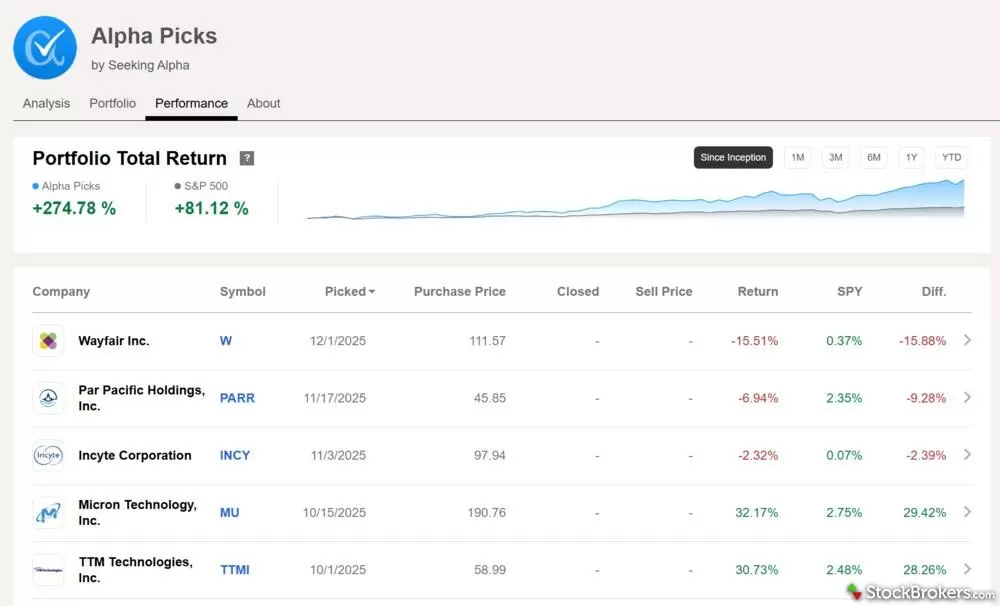
Alpha Picks is Seeking Alpha’s pre-built portfolio, designed to help investors find new stock ideas without building a strategy from scratch.
Investing groups and forums
For more support, you can join a wide range of Investing Groups and forums. You pick one that interests you, like biotech or value investing, and each group is run by an expert. You then get their investment picks, participate in Q&A sessions, and can chat with other investors in the group.
It’s a fun addition, but it isn’t cheap. Each instructor sets their own rate, with some costing about $40 a month and others costing hundreds of dollars. Costs could add up quickly if you join several.
I was disappointed that they didn’t have a free forum. I think they did in the past, but have since decided to limit community access to paid members, perhaps to keep moderation simpler.
Ease of use
Seeking Alpha is incredibly easy to use. It took no time at all to create an account and dive in, and even though there’s a lot of information across the platform, I found it visually pleasing and straightforward to digest. For example, the flow of the homepage made sense, moving from big-picture news to actual stock ideas and picks.
The screener was also fun to click through. I liked how simple it was to automatically find ideas, refine them, and then transfer them to my target portfolio. This was a highlight of my Seeking Alpha review.
That said, Seeking Alpha isn’t built for investors who want the most complex tools and features. It’s mostly articles, insights, and a screener, rather than advanced charting or backtesting. But within that scope, the platform felt very user-friendly.
If you do need help, you can submit a customer service support ticket through the platform. It’s a little barebones since there’s no phone or live chat support, but I don’t see many scenarios where most users would need lots of support to navigate the platform.
Final thoughts
Is Seeking Alpha worth it?
Seeking Alpha is an excellent source for market research, news, and investment ideas. The screener and other tools provide so much information while being fun and easy to use.
With a paid premium subscription, you’ll gain access to ratings and ideas from top investment quants and experts, including pre-selected investments picked by Seeking Alpha itself. I found the Seeking Alpha premium subscription well worth the cost.
Whether Seeking Alpha is worth it for you depends on how comfortable you are with detailed analysis and the experts behind the Seeking Alpha calculations. Since you get so much for free just by visiting Seeking Alpha’s website, consider giving it a test drive first, and if the information resonates, take it from there.
Alternatives to Seeking Alpha
As an alternative, TipRanks also offers one of the best screeners, but it generates analysis and recommendations using AI rather than human analysts and quants. Motley Fool is another source for articles and stock ideas, though its material is funnier, lighter, and more direct in telling you what to buy.
FAQs
Is Seeking Alpha trustworthy?
Yes, Seeking Alpha is a trustworthy source of financial articles, opinions, and advice. It also compiles excellent research from professional analysts and quants for its screener and portfolio analysis tools.
That said, the articles themselves are crowdsourced and published by all users, so the quality can vary quite a bit depending on the author. Be sure to study up on an author’s background before trusting the advice.
What is included in the free version of Seeking Alpha?
The free version of Seeking Alpha includes access to the general market news, basic portfolio insights, the screener, and some articles. However, a lot of the valuable data is blocked, such as the quant and analysis rankings on the screener. You also don’t see Seeking Alpha’s picks for investments.
How does Seeking Alpha compare to Motley Fool?
While both companies provide articles and investment ideas, Seeking Alpha is more analytical and complex. The articles are more quantitative, number-focused, and investors are more on their own to decide what to do.
Motley Fool’s articles are simpler, more humorous, and tend to give more specific ideas for what stocks to buy, rather than leaving readers to do their own research based on the analysis.
Does Seeking Alpha have a free trial?
Yes. Seeking Alpha Premium includes a 7-day free trial for new subscribers. If you don't cancel before it ends, the plan converts to the annual rate. The Pro plan doesn't have a free trial, but you can start with a reduced first month. Alpha Picks, sold separately, has no free trial and bills annually upfront.
StockBrokers.com Review Methodology
Why you should trust us
David Rodeck, a contributing writer for StockBrokers.com, has over a decade of writing experience specializing in investing, trading, and retirement planning. Before becoming a full-time writer, David was a financial advisor and passed the Series 6 and CFP exams. He has written for AARP, Kiplinger Magazine, Forbes Advisor, and Investopedia.
Blain Reinkensmeyer, co-founder of StockBrokers.com, has been investing and trading for over 25 years. After having placed over 2,000 trades in his late teens and early 20s, he became one of the first in digital media to review online brokerages. Today, Blain is widely respected as a leading expert on finance and investing, specifically the U.S. online brokerage industry. Blain has been quoted in The New York Times, The Wall Street Journal, Forbes, and Fast Company, among others. Blain created the original scoring rubrics for StockBrokers.com and oversees all testing and rating methodologies.
How we tested
- We used paid trading tool accounts for testing.
- We collected dozens of data points across the tools we review.
- We tested each tool’s website, desktop platforms, and mobile app, where applicable.
- We maintained strict editorial independence; trading tools cannot pay for a higher rating.
Our researchers thoroughly test a wide range of popular trading tools' features, such as trading journals and screeners, charting providers, and educational resources. We also evaluate the overall design of each tool’s mobile experience and look for a fluid user experience moving between mobile and desktop tools.
At StockBrokers.com, our reviewers use a variety of devices to evaluate trading tools. Our reviews and data collection are conducted using the following devices: iPhone SE running iOS 17.5.1, MacBook Pro M1 with 8 GB RAM running the current MacOS, and a Dell Vostro 5402 laptop i5 with 8 GB RAM running Windows 11 Pro.
Each trading tool was evaluated and scored across three key categories: Ease of Use, Features, and Cost. Learn more about how we test.
Trading tools tested in 2026
We tested 11 trading tools and service providers for stock traders in 2026:
Read next
TradingView has a free plan plus paid tiers from $14.95/mo. Our hands-on review covers pricing, charting, screeners, and whether TradingView is worth it in 2026.
David Rodeck August 19, 2026
TipRanks uses AI and big data to rate stocks and spot ideas. Read our review to learn its pros, cons, pricing, and if it’s right for your portfolio.
David Rodeck May 15, 2026
Read our Finviz review and see how it delivers advanced filtering, interactive heat maps, and in-depth financial visualizations.
David Rodeck August 25, 2026
Read our Stock Rover review and learn how its advanced screeners, portfolio insights, and research tools stack up for serious, data-driven investors.
David Rodeck September 14, 2026Trading tool guides
Download a free trading journal spreadsheet in Excel or Google Sheets to track profits, losses, and lessons learned. Build better trading habits today.
Blain Reinkensmeyer September 17, 2026
We tested the best trading journals of 2026. See why Tradervue tops our list, plus top picks for free journals, mobile apps, and every asset class.
David Rodeck August 25, 2026
Discover the best free and paid stock screeners. Compare TradingView, Finviz, Yahoo Finance, and more to find the right tool for stock filtering and analysis.
Blain Reinkensmeyer September 14, 2026
Learn to trade stocks step by step: open a broker account, practice with a simulator, and place your first trade. A beginner's guide from a 25-year trader.
Blain Reinkensmeyer August 26, 2026
Compare the best AI trading platforms, apps, and bots for 2026. We tested Trade Ideas, TrendSpider, and more to find the top AI stock trading tools for every type of investor.
Steven Hatzakis September 18, 2026
TradingView, StockCharts, and Yahoo Finance offer the best free stock charts. Compare features, fees, and free vs. paid tiers for the top 5 tools of 2026.
Blain Reinkensmeyer June 04, 2026Other guides
Explore the best international brokers for U.S. investors. Compare Interactive Brokers, Charles Schwab, and Fidelity for global stock trading access.
Jessica Inskip May 22, 2026
Find the best brokerage for high-net-worth investors. Compare Fidelity, Schwab, Merrill, and more for premium services and tailored investment tools.
Jessica Inskip January 27, 2026
Discover the best brokers for trade execution. Compare Fidelity, Interactive Brokers, and more for price improvement, speed, and transparency.
Jessica Inskip May 22, 2026
Find the best Roth IRA accounts. Fidelity, Schwab, and E*TRADE lead with low fees, smart investing tools, and retirement planning support.
Andrea Coombes April 27, 2026
Find the best rollover IRA accounts. Compare Fidelity, Schwab, and E*TRADE for easy transfers, low fees, and smart retirement investing tools.
Andrea Coombes May 15, 2026
Discover the best day trading platforms. Compare IBKR, Schwab, Fidelity, E*TRADE, and TradeStation for speed, tools, and margin rates.
Jessica Inskip August 03, 2026
Find the best crypto trading platform for 2026. We rank eToro, Fidelity, Interactive Brokers, Webull, and Robinhood on fees, security, and coin selection.
Steven Hatzakis May 27, 2026
Interactive Brokers and Fidelity lead our 2026 ranking of the best free stock trading platforms, tested on the true cost of $0 commissions and hidden fees.
Jessica Inskip September 02, 2026
Find the best IRA accounts. Compare Fidelity, Schwab, Merrill Edge, E*TRADE, & J.P. Morgan for retirement planning, fees, tools, and account flexibility.
Jessica Inskip March 31, 2026
Find the best penny stock brokers. Compare Fidelity, Firstrade, Schwab, E*TRADE, and TradeStation for OTC access, fees, and tools.
Jessica Inskip August 02, 2026
Find the top bank brokerages. From Merrill Edge to Ally, discover brokers that combine banking, investing, and rewards in one account.
Jessica Inskip April 16, 2026
We tested the best options trading platforms for 2026. Compare tastytrade, Fidelity, IBKR, E*TRADE & Schwab on tools, fees, and picks for beginners.
Jessica Inskip September 09, 2026
Discover the best stock brokers of 2026. Compare Schwab, Fidelity, Interactive Brokers, E*TRADE, and more to find the top trading platform for your needs.
Jessica Inskip August 06, 2026
Start investing with ease. Explore the best beginner-friendly trading platforms with low fees, great education, and intuitive apps.
Jessica Inskip August 06, 2026
Find top U.S. forex brokers. From tastyfx to OANDA, explore platforms with strong regulation, great tools, and user-friendly trading.
Steven Hatzakis May 29, 2026
We tested the 5 best futures trading platforms of 2026. Compare commissions, margin rates, and tools for beginners and active traders. Find the right platform for you.
Jessica Inskip September 17, 2026
Practice investing risk-free with the best paper trading platforms. Compare Webull, Schwab, Interactive Brokers, E*TRADE, and more.
Jessica Inskip July 24, 2026About the Editorial Team
David Rodeck is a financial writer based in New York City. He specializes in making investing, trading, and retirement planning understandable. David’s work has appeared in AARP, Kiplinger, Forbes Advisor, and Investopedia. Before writing full-time, David was a financial advisor and passed the Series 6 and CFP exams.
Joey Shadeck is the Content Strategist and Research Analyst for StockBrokers.com. He holds dual degrees in Finance and Marketing from Oakland University, and has been an active trader and investor for close to 10 years. An industry veteran, Joey obtains and verifies data, conducts research, and analyzes and validates our content.
Hannah Smith is a Staff Editor at StockBrokers.com. With a background in SEO and years of experience in digital media, Hannah is focused on creating high-quality, data-driven content that helps investors make informed decisions. With a master's degree in English from North Carolina State University, she brings a strong foundation in writing, research, and editorial strategy to her work.