 Charles Schwab
 Fidelity
 Interactive Brokers
 E*TRADE
 Webull
 TradeStation
 tastytrade
 Trading 212
 Interactive Investor
 IG
IG Interactive Brokers
 XTB
XTB Hargreaves Lansdown
 Saxo
Saxo eToro
eToro Charles Stanley Direct
 Finviz
 Stock Rover
 Seeking Alpha
 TipRanks
 TrendSpider
 Trade Ideas
 TraderSync
 TradingView
 Tradervue
 TradeZella
Best International Brokers for Stock Trading in 2026

Written by Jessica Inskip
Director of Investor Research

Edited by Hannah Smith
Staff Editor

Fact-checked by Steven Hatzakis
Director of Online Broker Research

Reviewed by Blain Reinkensmeyer
Managing Partner
Jessica InskipDirector of Investor Research
Jessica Inskip is Director of Investor Research at StockBrokers.com, bringing 15 years of experience in brokerage and trading strategy. Jessica focuses on investor education and brokerage industry research.


 Why you can trust us
Led by Jessica Inskip, Director of Investor Research, the StockBrokers.com research team collects thousands of data points across hundreds of variables. We evaluate features important to every kind of investor, including beginners, casual investors, passive investors, and active traders. We carefully track data on margin rates, trading costs, and fees to rate stock brokers across our proprietary testing categories.
Our researchers open personal brokerage accounts and test all available platforms on desktop, web, and mobile for each broker reviewed on StockBrokers.com. Learn more about how we test.
Investing internationally can help U.S. investors add global exposure to their portfolios, whether they live in the United States or abroad. This guide compares brokers that allow U.S. citizens to trade foreign stocks, with a focus on market access, pricing, platform usability, and account availability.
Our rankings are based on hands-on broker research and testing, including the number of international markets available, where U.S. clients can open accounts, overall ease of use, and trading costs.
Best International Brokers for Stock Trading
We selected brokers that make international investing accessible and practical for U.S. investors. Our testing focused on factors such as foreign stock availability, account accessibility, trading technology, research resources, and the overall experience of managing investments across global markets.
- Minimum Deposit: $0.00
- Stock Trades: $0.00
- Options (Per Contract): $0.65
Interactive Brokers is in a class of its own regarding foreign stock investing, offering more than 90 market centers and a smorgasbord of analytical tools. The broker’s Global Trader mobile app is stellar, and costs are low. Read full review
- 150+ markets to trade.
- IBKR Desktop platform has institutional power and intuitive usability.
- Industry-leading margin rates and competitive interest yields.
- Density of features requires a significant time investment.
- Educational content skips over the basics for true beginners.
- Certain tools lack the curated context needed.
- Minimum Deposit: $0.00
- Stock Trades: $0.00
- Options (Per Contract): $0.65
Charles Schwab’s long-term approach to investing is appealing, though international trading is clearly a feature, not a priority . Trading is facilitated in 12 countries and the broker charges less than rival Fidelity for trade commissions. Read full review
- thinkorswim is the industry benchmark for professional-grade trading and charting.
- Best in Class Research features actionable daily updates and deep fundamental data.
- Top-tier education with webinars, videos, and courses.
- No spot crypto trading (limited to ETFs and futures).
- "Stock Slices" (fractional shares) are limited to S&P 500 companies.
- Base margin rates are significantly higher than dedicated low-cost competitors.
- Minimum Deposit: $0.00
- Stock Trades: $0.00
- Options (Per Contract): $0.65
Fidelity is a strong choice if global investing is not your top priority when selecting a broker. It offers access to 25 countries and the ability to trade international equities. Commissions vary by country. Read full review
- Excellent research and mobile app
- Top-notch education
- Decades of reliable client service
- No dedicated mobile app for active trading
Compare trading platforms head-to-head
Use the broker comparison tool to compare over 150 different account features and fees.
Winners Summary
1. Interactive Brokers - Best broker for international trading
| Company | Overall | Minimum Deposit | Stock Trades | Options (Per Contract) |
 Interactive Brokers Interactive Brokers
|
|
$0.00 | $0.00 | $0.65 |
Global reach in a class of its own. Interactive Brokers (IBKR) consistently ranks as Best in Class across our StockBrokers.com categories, but international stock trading is where IBKR truly separates itself. Clients can trade in over 90 market centers worldwide, and the GlobalAnalyst tool is a standout. It screens stocks across the globe and allows comparisons in a single currency, which is invaluable when weighing a Toronto-listed company against one in Tokyo. Getting my account approved for international trading was a painless process.
Highly competitive international commissions. Pricing varies by country, but it remains remarkably competitive across the board. My test trade of one share of Air Canada in Canadian dollars cost a $1 minimum ticket plus a 20 basis point FX spread (one-fifth of a percent), exceptionally low by global standards. There is no minimum deposit and no monthly fees beyond any optional data feeds, so there is little risk in opening an account to explore the platform.
Global Trader app is a game-changer for beginners. While IBKR's flagship platform is built for institutional and active traders, the Global Trader mobile app is a strong entry point for newer global investors. I was able to purchase Canadian stock and view my CAD-denominated holdings right alongside my USD positions seamlessly. I would also recommend Global Trader for U.S.-focused beginners looking for a streamlined experience.
Jessica's take:
"IBKR's 90+ market centers and the GlobalAnalyst screener, which compares stocks worldwide in a single currency, make it a top choice for serious international investors seeking real depth."
Jessica Inskip
Director of Investor Research
Accessible to U.S. expats. If you are a U.S. citizen living abroad, you can apply using your legal domicile, a door that many brokers keep firmly shut.

Interactive Brokers offers one of the most comprehensive watchlists in the industry, available on both its web and desktop trading platforms. This screenshot highlights the desktop experience, where investors can track real-time quotes, market data, and customizable columns across multiple asset classes.
2. Charles Schwab - Best for long-term investing
| Company | Overall | Minimum Deposit | Stock Trades | Options (Per Contract) |
 Charles Schwab Charles Schwab
|
|
$0.00 | $0.00 | $0.65 |
A top pick for long-term international investors. Charles Schwab stands out as our pick for long-term investors looking to trade foreign stocks, combining competitive fees with solid support for international markets. Schwab charges lower trade commissions than Fidelity, which adds up significantly across a long-term portfolio. It also applies the same 1% currency spread as Fidelity, making it cost-effective when converting currencies for international trades. Opening a Schwab Global Account does require a paper application, which is a minor inconvenience, but the process ensures compliance with international regulations.
Access to 12 international markets. Schwab's global reach is a key advantage for long-term investors. With access to 12 international markets, including popular exchanges in Europe and Asia, investors can diversify portfolios globally with relative ease. I found the platform offers seamless tools for monitoring and managing international holdings, making it straightforward to track performance and make informed decisions. For long-term investors focused on stable returns, this level of diversification can meaningfully reduce risk while providing exposure to growth in foreign markets.
Use the specialized international line. If you have questions about using Schwab for international trading or opening an account from a foreign country, skip the general U.S. helpline. When I called Schwab's standard support line, the reps were not trained to answer questions about international trading. Their specialized international account line (800-992-4685) is the better route, and those representatives were far more equipped to help.
Strong all-around solution. For long-term investors navigating international markets, Schwab's combination of competitive fees, broad market access, and specialized support makes it a standout choice among U.S. brokers.

Schwab’s options trade ticket on mobile features a trade calculator view with both a P/L diagram and detailed table analysis. In this example, a 30-day-to-expiration at-the-money (ATM) cash-secured put on AAPL is displayed, clearly showing limited profit potential capped at the premium received—regardless of how high the stock rises. The payoff diagram also illustrates the increasing downside risk, mirroring the risk profile of stock ownership and highlighting the neutral to bullish bias of this strategy.
Forex trading at Schwab
Learn all about Schwab's forex offering by reading the Schwab review on ForexBrokers.com. Home of the most comprehensive forex review in the industry, you can check out forex reviews of 60+ brokers.
3. Fidelity - Best for customer service
| Company | Overall | Minimum Deposit | Stock Trades | Options (Per Contract) |
 Fidelity Fidelity
|
|
$0.00 | $0.00 | $0.65 |
A solid choice for blending domestic and international. Fidelity is a strong option for U.S. investors who want the ability to trade foreign stocks while maintaining access to a wide range of domestic investment options. The platform combines an intuitive interface with comprehensive research tools and well-regarded customer service. While its international trading features are not as extensive as those of niche brokers like Interactive Brokers, Fidelity provides enough global reach for most investors. Its ability to trade in 25 countries and 16 currencies is a notable offering for a full-service U.S. brokerage.
Higher commissions and currency spreads. Pricing varies by country, and currency conversion carries a 1% spread on each side of the trade, which can add up. My test trade of one share of Air Canada stock cost $19 CAD plus the 1% currency conversion on each side. That is several multiples of what Interactive Brokers charges for a comparable trade, so cost-conscious international traders should weigh this carefully when evaluating Fidelity for foreign equity trading.
Integration with broader investment tools. Fidelity's international capabilities integrate with its broader range of investment, retirement, and research tools. This makes it a reasonable option for investors looking to diversify globally without sacrificing access to U.S. markets or the planning resources Fidelity is known for.
Options for U.S. expats. For expats or clients who move abroad, Fidelity offers options for maintaining accounts and accessing both U.S. and international markets. Existing clients living outside the U.S. can contact Fidelity directly to discuss tailored account solutions, which supports continuity for those with established portfolios.
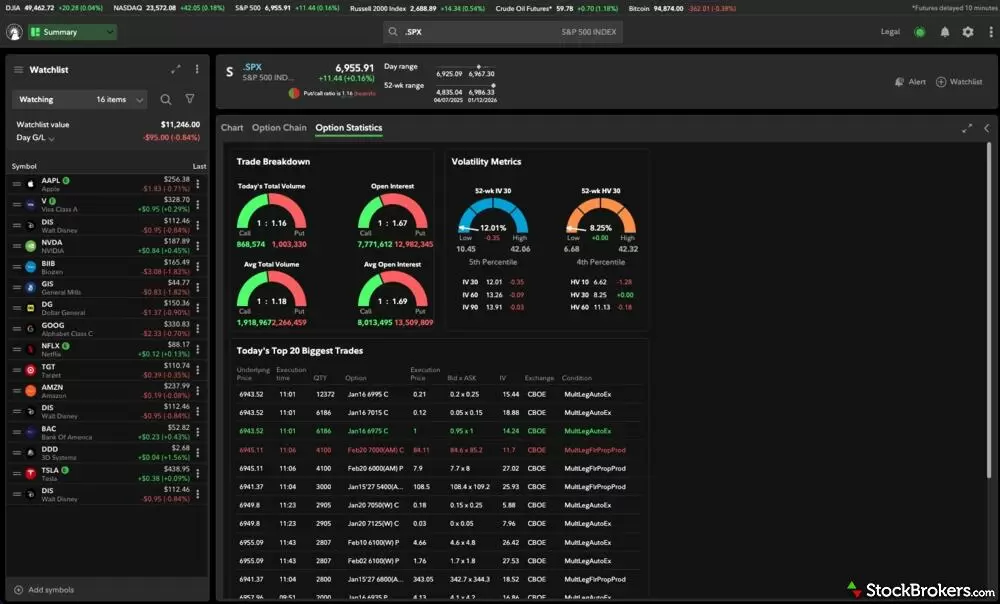
Fidelity’s trading dashboard brings everything together in one place. Here, I’ve linked SPY across all widgets for a seamless view. You can dive into options statistics, volatility indices, and my personal favorite: the trade breakdown activity, which gives great insight into how traders are positioning.
Are you a citizen of Australia, Canada, or the United Kingdom?
Check out our reviews of top-rated brokers in your country:
Read next
- Best Day Trading Platforms and Apps for 2026
- Best Stock Brokers for 2026
- Best Stock Trading Apps for 2026
- Best Paper Trading Apps & Platforms for 2026
- Best Stock Trading Platforms for Beginners of 2026
- Best Brokers for Penny Stock Trading of 2026
- Best Options Trading Platforms for 2026
- Best Futures Trading Platforms for 2026
More guides
Practice investing risk-free with the best paper trading platforms. Compare Webull, Schwab, Interactive Brokers, E*TRADE, and more.
Jessica Inskip March 30, 2026
Find the best rollover IRA accounts. Compare Fidelity, Schwab, and E*TRADE for easy transfers, low fees, and smart retirement investing tools.
Andrea Coombes May 15, 2026
Find the best Roth IRA accounts. Fidelity, Schwab, and E*TRADE lead with low fees, smart investing tools, and retirement planning support.
Andrea Coombes April 27, 2026
Discover the best day trading platforms. Compare IBKR, Schwab, Fidelity, E*TRADE, and TradeStation for speed, tools, and margin rates.
Jessica Inskip May 21, 2026
Find top U.S. forex brokers. From tastyfx to OANDA, explore platforms with strong regulation, great tools, and user-friendly trading.
Steven Hatzakis May 29, 2026
Find the best IRA accounts. Compare Fidelity, Schwab, Merrill Edge, E*TRADE, & J.P. Morgan for retirement planning, fees, tools, and account flexibility.
Jessica Inskip March 31, 2026
Find the best crypto trading platform for 2026. We rank eToro, Fidelity, Interactive Brokers, Webull, and Robinhood on fees, security, and coin selection.
Steven Hatzakis May 26, 2026
Discover the best options trading platforms. Compare tastytrade, Schwab, IBKR, Fidelity & E*TRADE for tools, pricing, strategies, and trader support.
Jessica Inskip March 23, 2026
Find the best penny stock brokers. Compare Fidelity, Firstrade, Schwab, E*TRADE, and TradeStation for OTC access, fees, and tools.
Jessica Inskip May 05, 2026
Find the best brokerage for high-net-worth investors. Compare Fidelity, Schwab, Merrill, and more for premium services and tailored investment tools.
Jessica Inskip January 27, 2026
Find the top bank brokerages. From Merrill Edge to Ally, discover brokers that combine banking, investing, and rewards in one account.
Jessica Inskip April 16, 2026
Find the best free trading platform of 2026. We tested the top brokers to uncover the true cost of $0 commissions. Find your ideal free stock trading app.
Jessica Inskip March 30, 2026
Discover the best stock brokers of 2026. Compare Schwab, Fidelity, Interactive Brokers, E*TRADE, and more to find the top trading platform for your needs.
Jessica Inskip May 07, 2026
We tested the 5 best futures trading platforms of 2026. Compare commissions, margin rates, and tools for beginners and active traders. Find the right platform for you.
Jessica Inskip May 13, 2026
Start investing with ease. Explore the best beginner-friendly trading platforms with low fees, great education, and intuitive apps.
Jessica Inskip June 10, 2026
Discover the best brokers for trade execution. Compare Fidelity, Interactive Brokers, and more for price improvement, speed, and transparency.
Jessica Inskip May 22, 2026Popular stock broker reviews
Read our Charles Schwab review to learn why its platforms, research, and investor resources make it one of the top-ranked brokerages.
Jessica Inskip May 04, 2026
Read our Merrill Edge Self-Directed review and see how it combines powerful investing tools, robust research, and integrated banking benefits.
Jessica Inskip May 04, 2026
Read our TradeStation review and discover why its pro-level tools, deep customization, and options focus make it a top choice for active traders.
Jessica Inskip May 04, 2026
Read our Public.com review to learn how its intuitive platform and community-driven features help simplify investing for first-time traders.
Jessica Inskip May 04, 2026
Read our 2026 E*TRADE review to see how powerful research, versatile platforms, and diverse investments make it a top choice for all investors.
Jessica Inskip May 04, 2026
Read our Webull review and discover its commission-free trading, sleek platforms, paper trading tools, and fractional shares.
Jessica Inskip May 07, 2026
Read our Interactive Brokers review and see why it’s a top choice for active traders with low costs, cutting-edge platforms, and global reach.
Jessica Inskip May 04, 2026
Read our Fidelity review and discover how its powerful tools, in-depth education, and no-fee trading set the standard for online investing.
Jessica Inskip May 26, 2026
Read our Ally Invest review to explore its user-friendly platform, automated investing portfolios, and wide range of investment options.
Jessica Inskip May 04, 2026
Read our Robinhood review and see why it’s a top pick for beginners, with a sleek mobile app, zero commissions, and standout educational tools.
Jessica Inskip June 11, 2026
Read our eToro review to explore its interactive platform, built-in discussions, and tools for crypto and stock investing.
Jessica Inskip May 20, 2026
Read our tastytrade review and discover why it’s the top choice for options traders, with low fees, advanced tools, and a seamless platform.
Jessica Inskip May 04, 2026
Read our J.P. Morgan Self-Directed Investing review and discover its strengths in research, planning tools, and integration for Chase clients.
Jessica Inskip May 15, 2026
Read our Firstrade review and see why it’s a top choice for options traders, offering $0 contract fees, robust tools, and a growing feature set.
Jessica Inskip May 04, 2026About the Editorial Team
Jessica Inskip is Director of Investor Research at StockBrokers.com, bringing 15 years of experience in brokerage and trading strategy. A former FINRA-licensed rep, she held Series 7, 63, 66, and 4 licenses. Jessica focuses on investor education and brokerage industry research, appears regularly on CNBC, Fox Business, and Bloomberg, and hosts the Market MakeHer podcast.
Hannah Smith is a Staff Editor at StockBrokers.com. With a background in SEO and years of experience in digital media, Hannah is focused on creating high-quality, data-driven content that helps investors make informed decisions. With a master's degree in English from North Carolina State University, she brings a strong foundation in writing, research, and editorial strategy to her work.
Steven Hatzakis is the Global Director of Research for ForexBrokers.com. Steven previously served as an Editor for Finance Magnates, where he authored over 1,000 published articles about the online finance industry. Steven is an active fintech and crypto industry researcher and advises blockchain companies at the board level. Over the past 20 years, Steven has held numerous positions within the international forex markets, from writing to consulting to serving as a registered commodity futures representative.
Blain Reinkensmeyer has 20 years of trading experience with over 2,500 trades placed during that time. He heads research for all U.S.-based brokerages on StockBrokers.com and is respected by executives as the leading expert covering the online broker industry. Blain’s insights have been featured in the New York Times, Wall Street Journal, Forbes, and the Chicago Tribune, among other media outlets.